
Walk a North Miami Street
A North Miami street directory works best as a chain of official sources. Ownership, occupancy, and postal identity are different facts. The Miami-Dade Property Search ties a street address to a parcel and owner, but a tax owner may live elsewhere. Its folio and legal description then give the stable keys needed for deed research. A folio is the county's parcel identifier. The legal description names the land by subdivision, lot, block, and plat rather than by its changeable street label.
- Normalize the address. Keep NE or NW, the street type, and any suite or unit. Search the exact number before trying a spelling variant.
- Open the parcel card. Record the folio, municipality, owner, mailing address, situs address, subdivision, lot and block, use code, exemptions, year built, and sale references.
- Use the parcel map. Zoom until boundaries show, then click each adjoining polygon in street order. Corner lots may use the cross street.
- Carry the legal description into the Recorder index. Match each deed to the same land, then separate grantors, grantees, and mailing addresses by date.
- Add city permits, a lawful voter-file extract, and a reverse directory for the period being studied. Date-stamp every result.
This sequence prevents a common street-by-street mistake: treating records from different years as one current household list. The assessment roll can lag a recent deed. A directory may reflect a canvass months before its edition date. Voter data is a registration snapshot, not proof that a person remains at an address.
North Miami Street Search Fields
The county appraiser offers several ways into the same parcel system. Address is the natural route for a street directory search, while folio is best once a parcel has been identified. Owner and subdivision searches help when a number changed or an address fails. The map uses aerial imagery and parcel polygons, but the county warns that the roll is edited throughout the year and may not yet show a recent event.
| Portal field | Entry | Best street use |
|---|---|---|
| Address | Street number and name | Find the physical parcel |
| Suite | Unit text | Separate a condominium unit where indexed |
| Owner Name | Person or entity | Check other parcels tied to the same owner |
| Subdivision Name | Recorded subdivision | Recover a parcel when the street label fails |
| Folio | County parcel number | Return to one exact property |
A parcel result can show owner, mailing and site addresses, municipality, legal description, values, exemptions, building traits, sales, and map location. Mailing and situs addresses must stay in separate notes. The first is where tax mail goes; the second is the land's physical address. Neither, by itself, names all occupants.
North Miami Records by Address
Each source answers a narrower question than the phrase street directory suggests. The useful result comes from joining records through the folio, legal description, address, and date. When an online tool fails, Miami-Dade and North Miami also provide counter, mail, and records-request channels.
| Address source | Keeper | What it can establish | Access route |
|---|---|---|---|
| Parcel roll and map | Miami-Dade Property Appraiser | Owner, mailing and situs addresses, folio, sales | Free portal and map |
| Official Records | Miami-Dade Clerk/Recorder | Deeds, mortgages, liens, plats, and past parties | Free standard index; images or copies |
| Permits and code files | North Miami | Work, applicant, contractor, inspection events | Citizen ePortal or Chapter 119 request |
| Voter information | Miami-Dade Elections | Released registrants grouped by street | Lawful file request; protected fields removed |
| Reverse directories | MDPLS and HistoryMiami | Historic named household or phone at an address | Catalog, reference desk, or reading room |
North Miami permit files are supporting evidence. An applicant may be a contractor or agent rather than the owner. Local code records can be requested from the city, while escalated code matters may appear in Clerk systems. Narrow requests by department, street address, record type, and date span.
North Miami Parcels Become Deeds
The Miami-Dade County Recorder guide leads from the parcel to deeds, mortgages, liens, satisfactions, plats, judgments, and other recorded instruments. Search by party name, Clerk's File Number, record-date range, document type, book and page, or legal description. Standard search is free. Advanced searches use one-dollar units.
The official guide can be previewed here before opening the index.
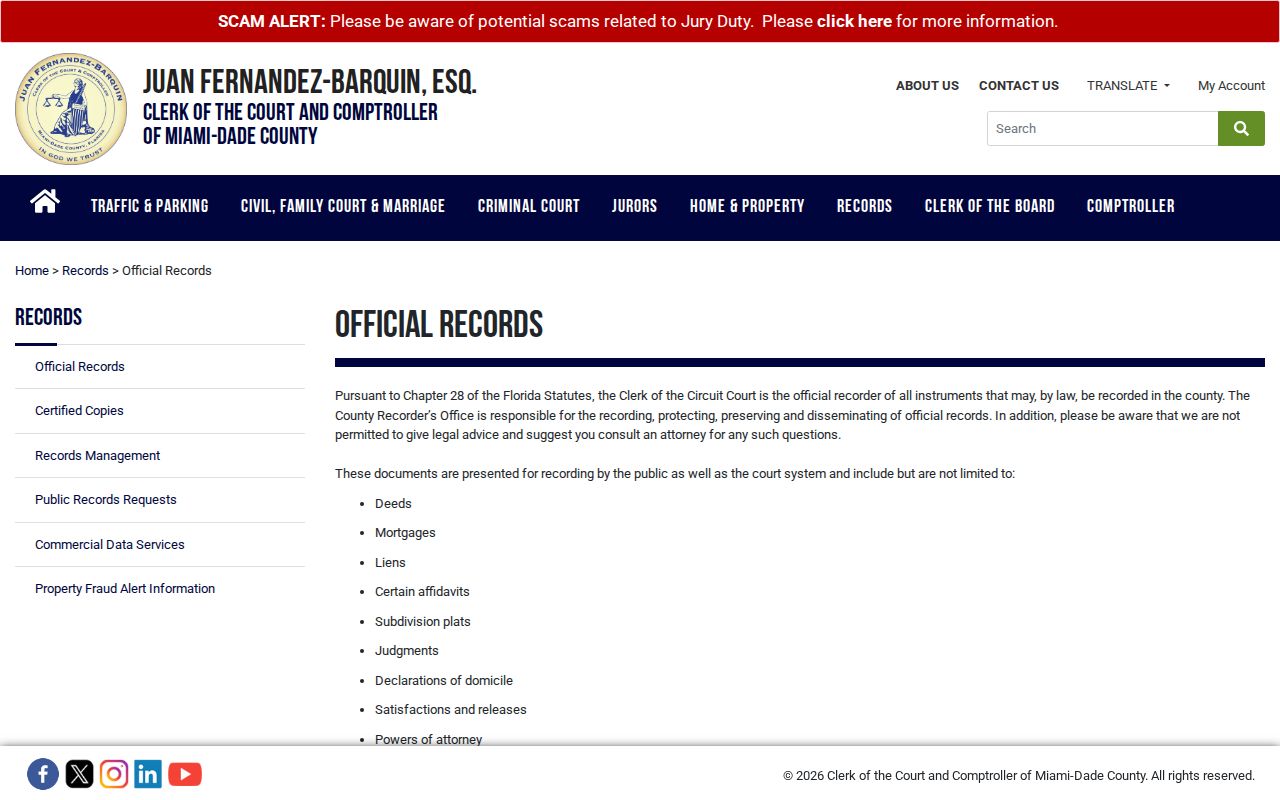
The captured page points to the county source that explains recorded-document access, the right place to verify a street directory deed trail.
A result usually supplies the CFN, record date, type, book and page, party names and roles, and legal-description cues. The deed image adds grantor, grantee, consideration or documentary stamps, execution details, preparer, return address, and the full legal description. Match the land first. The same street number can be reused, changed, or assigned to a different unit.
North Miami Before Online Records
Most Miami-Dade recorded documents from 1974 forward can be searched online. That date is a web boundary, not the start of the county's land history. The Records Library retains all recorded copies and indexes. Public computers support party, CFN, legal-description, and book-and-page searches. Staff historical searches cost $2 per name for each year, copies cost $1 per page, and certification adds $2.
The Records Library page shows the fallback for a North Miami street directory that crosses the online cutoff.
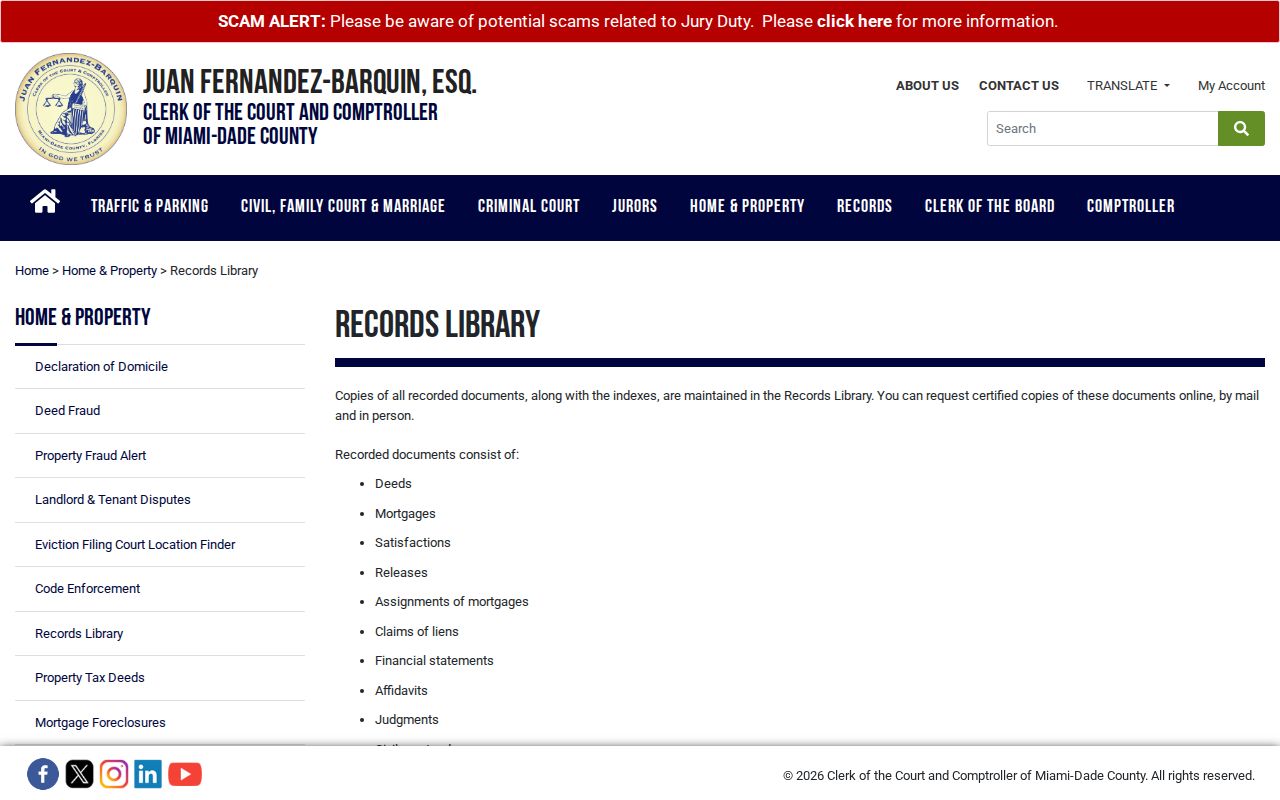
This source matters because an empty web result before 1974 does not mean that no deed or index entry exists.
Mail requests should give the full name and document type. For deeds and mortgages, add the property address or legal description. Send them to the Office of County Recorder, 20 NW 1st Avenue, Suite 5.246, Miami, FL 33128. In-person and mail access preserve the chain when the portal ends.
Note: Call 305-275-1155 before travel when an older volume may require staff retrieval from storage.
Decode North Miami Street Labels
North Miami uses Miami-Dade's directional grid. NE and NW are not minor details. Numbered streets and avenues cross the grid, while Biscayne Boulevard and West Dixie Highway are named-road exceptions. Portals may accept Street or St and may ignore punctuation, but a researcher should keep the literal form found in each record.
- Parcel
- A mapped unit of land identified by a county folio.
- Situs address
- The physical address assigned to the parcel, distinct from the owner's mailing address.
- Plat
- A recorded map that divides a subdivision into lots and blocks.
- Criss-cross directory
- A directory arranged by street address or phone number instead of surname.
A condominium adds another layer. One mapped shape may represent a unit, common element, whole building, or parent tract. Use the suite field when available. A building owner does not identify every occupant, and an association parcel should not be counted as a household.
North Miami Postal Address Myth
A North Miami mailing label does not prove that land lies inside North Miami. ZIP delivery areas and city limits answer different questions. Use USPS for current mailing form, then verify the municipality field in Miami-Dade Property Search. The distinction is especially important near western unincorporated areas and the eastern edge shaped by old boundary changes.
Property mailing address, situs, and deed legal description answer three separate questions: where tax mail goes, where the parcel sits, and which land title controls. Retain all three rather than forcing them to match. When city jurisdiction matters, compare the parcel municipality with North Miami district or boundary material.
North Miami's numbered grid makes the sequence easier to test when it is copied with care. NE 125 Street has a quadrant, number, and street type, while Biscayne Boulevard and West Dixie Highway do not follow the same numbered-road form. County and city indexes may omit punctuation or spell out an ordinal. Try those harmless format changes only after preserving the original entry. Never switch NE to NW to force a result. For an apartment, search the unit first and then the parent address, since a missing suite can return a whole-building parcel instead of the intended unit.
North Miami Streets in Print
A reverse volume can add historic occupants and telephone listings that property records do not show. Miami-Dade Public Library System and HistoryMiami hold Miami city directories and telephone material, but no public catalog page promises a complete North Miami year run. Ask by place, year, publisher, and format. Useful catalog terms include North Miami, Arch Creek, Miami Shores, Polk, suburban, telephone, reverse, and criss-cross.
Read the street section and then check the person's alphabetical entry for a spouse notation, occupation, or homeowner mark. Absence is weak evidence. A directory can omit recent movers, children, boarders, people outside the publisher's canvass, or households without listed service. The North Miami directory book page explains the collections themselves; the street directory use is narrower and address-led.
Older Names, Same North Miami Land
North Miami records may be cataloged under Arch Creek, Town of Miami Shores, Town of North Miami, or City of North Miami. The municipality incorporated as Town of Miami Shores in 1926, changed to Town of North Miami after a 1931 boundary episode, and took its current city name in 1953. Those names can break a modern address search even when the land is unchanged.
No official street-by-street renumbering table was found in the research. If an old address fails, compare the plat name, lot and block, cross streets, a directory street guide, and a historic aerial. A Chapter 119 request to city planning or GIS can ask for an address-assignment or renaming ordinance by old name, new name, and approximate date.
The city's physical record also changed as canal drainage, 1920s subdivision, and postwar construction remade former Arch Creek land. By 1951, North Miami was described as one of the nation's fastest-growing towns. That growth makes plats, permits, deeds, the 1945 Florida census, early aerials, and city directories especially useful together. A newer structure may sit on an older legal lot, so a missing house is not the end of an address trail. Follow the parcel and subdivision even when the building, street label, or city boundary has changed.
North Miami Street Record Access
Florida Public Records Law gives any person a right to inspect and copy nonexempt public records at a reasonable time. Section 119.07 requires prompt acknowledgment and a good-faith response, but it sets no fixed number of business days. If no special fee applies, ordinary paper copies may cost up to 15 cents for one-sided pages, with actual-cost or extensive-use charges possible for broader work.
The inspection and copying rule is useful when no address index is advertised. Ask for a specific record series, department, street address, fields, date range, and electronic format. An agency email may itself become a public record, so a requester who does not want to disclose an email address can call, mail, or visit instead.
The statute page is captured below as the direct source for access rules.
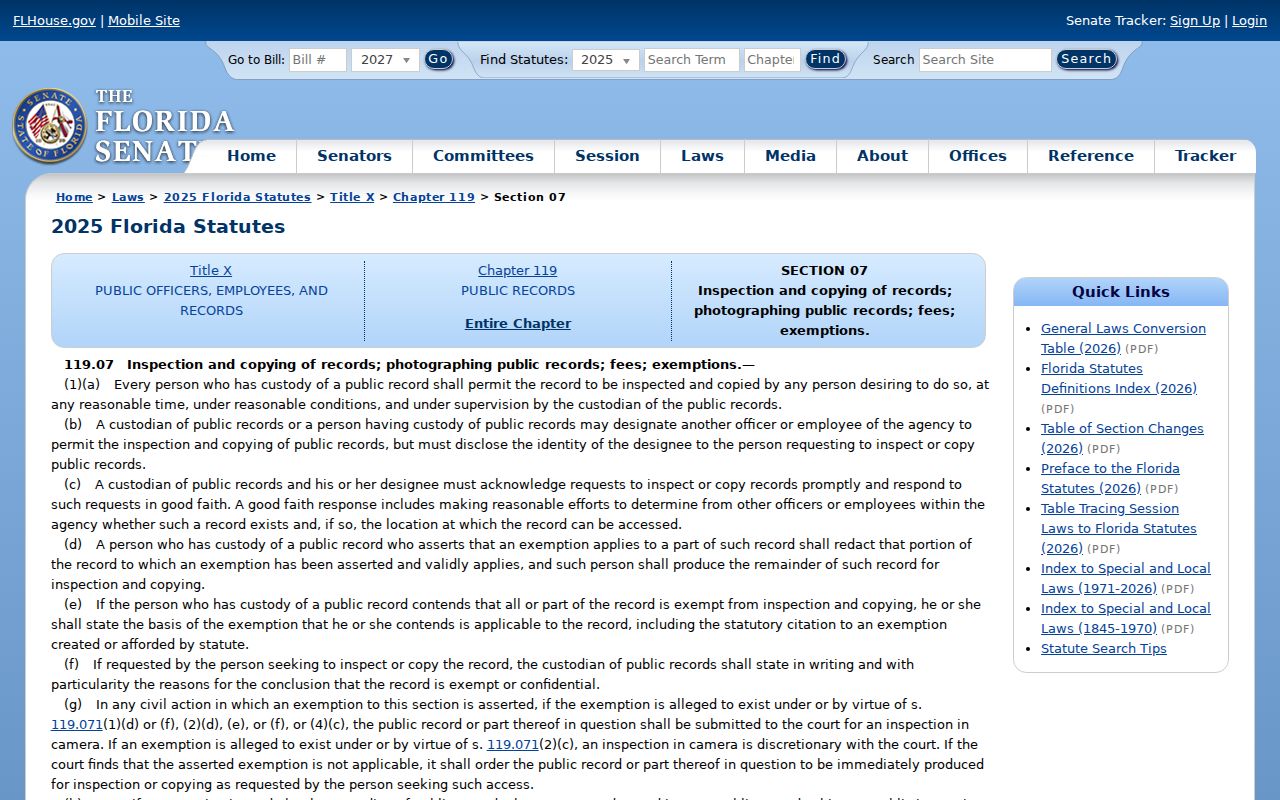
The text supports a request fallback without promising that exempt names, protected addresses, or private account data will be released.
Limits of North Miami Street Directories
A street directory cannot provide a complete current household roster. Property records identify owners, not every person living on the parcel. Voter data omits people who are not registered and withholds protected addresses and identifiers. Utility, delivery, and motor-vehicle customer data are not open household lists. Florida law also shields listed officials, safety-sensitive classes, and qualified participants in the Address Confidentiality Program.
The agency and motor-vehicle exemptions show why some address trails stop. The statute source appears below.
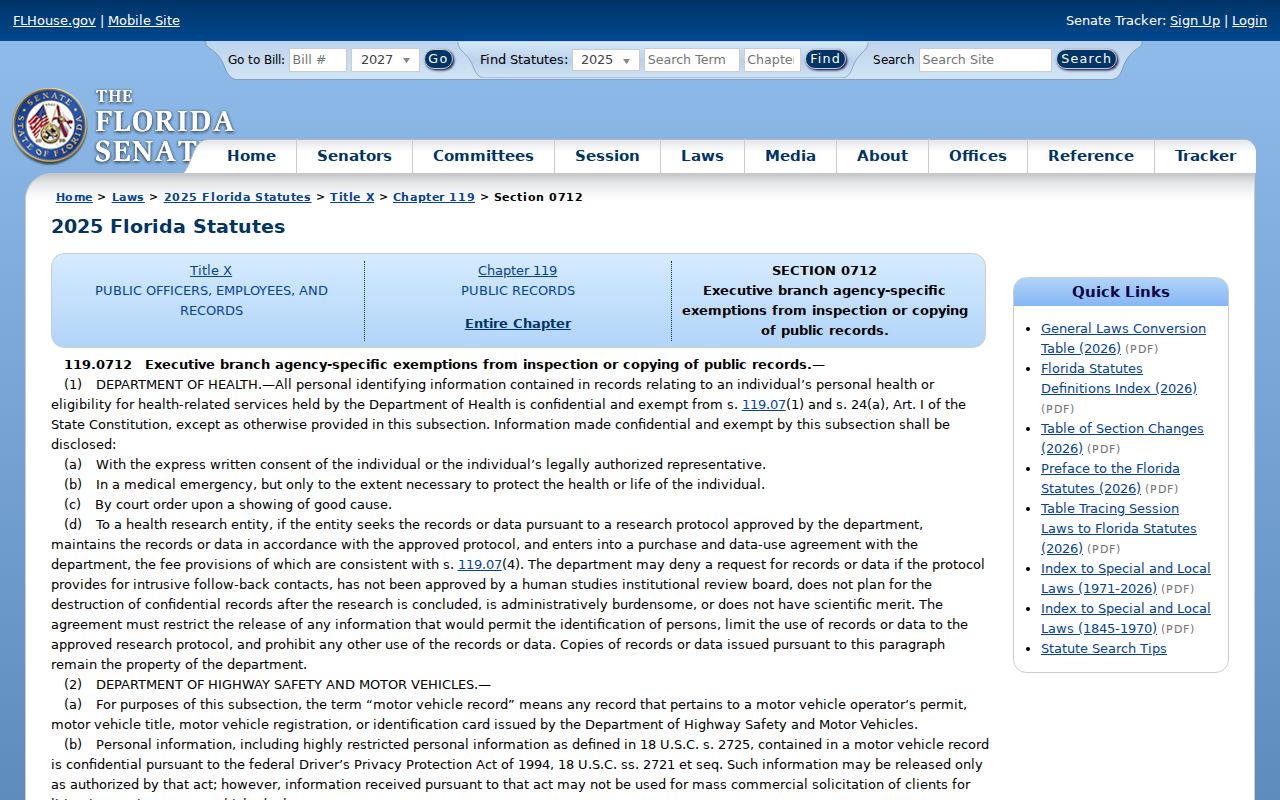
This boundary is part of a correct result, not a gap to work around by exposing protected data.
Lawful use. North Miami address records are for lawful personal research. Never use a street search to stalk, harass, threaten, or harm a person.